
Floyd County Criminal History Checks
No single office can produce every part of a Floyd County criminal history. Start by deciding whether the event is an arrest, a filed case, a conviction entry, a warrant, or a custody record. The District Clerk holds felony case files from the 110th District Court. The County Clerk is the usual custodian for Class A and B misdemeanor files. Municipal and justice courts keep fine-only matters. The Floyd County Sheriff holds sheriff-created reports and booking information, while the Texas Department of Public Safety maintains the statewide criminal-history repository.
Bring a full name, date of birth when lawfully available, spelling variants, an approximate event year, and any case or booking number. Floyd County's District Clerk tells users to give case numbers without commas or hyphens. A narrow request usually works better than asking a small office to research every possible record tied to a name.
- Identify the record and the agency that created it.
- Ask the proper clerk or sheriff for the case, report, or booking number.
- Review the docket or booking entry before ordering a full file.
- Compare the initial charge with the filed charge and final judgment.
- Use DPS or fingerprints when a statewide or identity-linked check is needed.
No One-Stop Floyd Criminal Search
The official Floyd County directory shows why the search is split among several offices. A city police report stays with the city agency. A sheriff booking remains a custody record. A prosecutor's filing becomes a court case, and DPS receives a later fingerprint-based reporting cycle. One layer can be present while another is delayed or absent. That is not proof that an office lost a record.
The county directory image below shows the local starting point for department contacts.
Use that official directory to select the record holder, then ask the office about its current submission method, copy cost, and access rules.
Floyd County record flow: arresting agency report → Sheriff booking → prosecutor review → District, County, municipal, or justice-court file → DPS disposition reporting.
Older Floyd County records may require a different path. The Texas State Library inventory shows local series preserved on microfilm and organized by the office that created them. For a historic case, give the clerk a year and record series, then ask whether the volume is still at the courthouse or has moved to a regional repository. The absence of a web result does not establish that no paper or filmed record exists.
Official Background Checks in Texas
The Texas DPS Crime Records Division offers a public name search for Texas convictions and deferred adjudications. It is not a full local case index. The current DPS help material says a search uses one $1 credit, and credit card purchases add a 2.25 percent charge plus $0.25 per transaction. Names and birth dates can point to the wrong person, so DPS warns that only fingerprints make a positive identity match.
The DPS service page pictured below connects the statewide repository to record review, correction, expunction, and nondisclosure resources.
For one's own Texas record, the official fingerprint route is FAST through IdentoGO. DPS lists a $15 record fee plus a $10 electronic capture fee. The live scheduler, not a static county list, determines the nearest appointment site.
| Official product | Method | Published cost |
|---|---|---|
| DPS public conviction search | Name and date of birth | $1 search credit, plus card surcharge |
| DPS personal review | FAST fingerprints | $15 record check plus $10 capture |
| FAST hard cards | Two fingerprint cards | $20 capture fee |
| Floyd clerk copy | Known local case | Confirm with the clerk |
Floyd Records in the DPS Search
The DPS Criminal History Conviction Name Search asks for a last name and first name, with middle name and date of birth as useful narrowing fields. Exact and Soundex-style matching can produce several possibilities. Each result must be compared with available descriptors. A record that looks close is still not proof of identity.
The captured DPS landing interface illustrates the statewide search entry used for Floyd County criminal records.
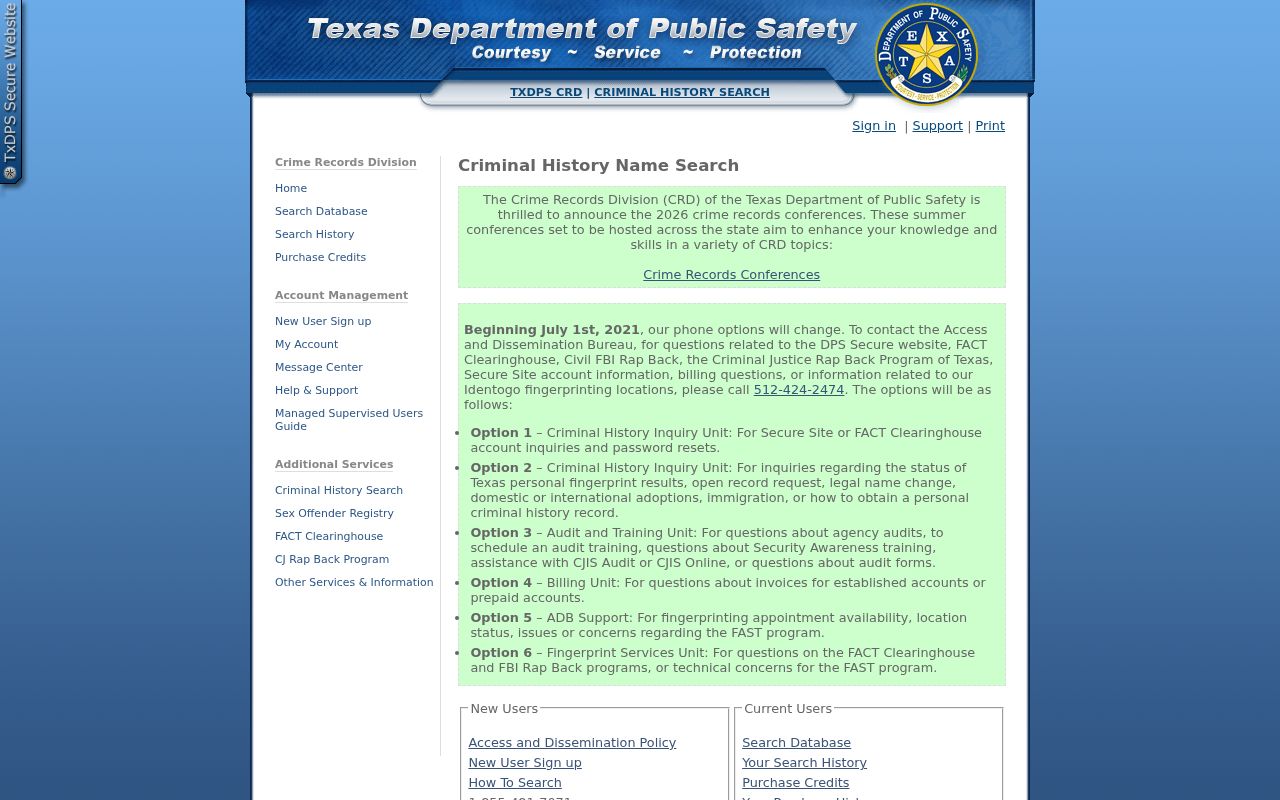
Save the returned record if it is needed for self-review. DPS retains search-history information, but that is not the same as preserving every result opened during the session.
| Search field | Use | Limit |
|---|---|---|
| Last and first name | Required identity search | Common names can return several people |
| Middle name | Optional narrowing | Search may also run without it |
| Date of birth | Strong narrowing value | Still not a fingerprint match |
| Exact match | Controls name matching | Spelling variants may be missed |
Kinds of Criminal Records
Floyd County criminal records describe different stages of one event. Police or deputies create the incident and arrest report. Intake staff create the booking entry. A magistrate records warnings, probable cause, and bail. Prosecutors decide what to file, and a clerk opens the case. DPS then connects fingerprinted arrests with reported prosecution and court outcomes. The result is a chain, not one interchangeable file.
Record ownership controls the request route. A Floydada Police narrative does not become a sheriff report merely because the person entered county custody. Likewise, a booking charge does not become the final court count. Use these distinctions when asking for copies:
- Arrest and booking records: allegations, intake, bond, and release details.
- Court case files: pleadings, docket events, orders, judgments, and costs.
- DPS histories: person-indexed Texas arrest cycles and reported outcomes.
- Warrant records: issuing court process and law-enforcement execution data.
- Custody and supervision records: county placement, TDCJ, community supervision, or parole data.
Probation is called community supervision in Texas. The public sentence or supervision order remains in the court file, while the 110th Judicial District CSCD keeps day-to-day supervision details that are not an ordinary open court record. Parole is different. The Texas Board of Pardons and Paroles makes release decisions, and the TDCJ Parole Division handles state supervision after release. These records should not be merged with a local booking entry.
Floyd County Court Record Stack
The Floyd County Courthouse at 105 South Main Street in Floydada places several key offices in one building. The 110th District Court is in Room 204. The District Clerk is in Room 207, the District Attorney is in Room 200, and the County Attorney is in Room 209. That compact layout helps in-person research, but no shared criminal-history counter exists. Felony files go to the District Clerk, while the County Clerk ordinarily handles Class A and B misdemeanor case files.
The county courthouse contact page supplied the building view below.
The image anchors the main records location, while the room list prevents a trip to the wrong custodian.
District Clerk
105 S. Main, Room 207
Floydada, TX 79235
806-983-4923
Floyd County Sheriff
125 E. California St.
Floydada, TX 79235
806-983-4901
JP Precincts 1 and 4
114 W. Virginia St.
Floydada, TX 79235
806-983-4911
County Clerk hours are published as 8 a.m. to 5 p.m. Monday through Thursday and 8 a.m. to 3 p.m. Friday. Filing stops one hour earlier each day. A copy request is not necessarily a filing, so call before relying on that schedule. The county does not publish courthouse parking, screening, locker, or accessible-entry details. Ask the specific office about current access before travel.
Floyd County Criminal Records: What They Contain
A court file centers on the case. It can show the case number, court, filing date, charge, attorneys, settings, motions, plea, judgment, sentence, bond, costs, and payment entries. A DPS history centers on a person and organizes events into arrest cycles. A booking file centers on custody and can show intake time, received charge, arresting agency, bond, and release or transfer. Missing data must be checked at the source rather than treated as a legal conclusion.
| Name and identifiers | Reported names, aliases, birth data, descriptors, SID, FBI number, and fingerprint identifiers when held. |
|---|---|
| Arrest and booking | Agency, date, tracking number, intake, charge received, bond, and release. |
| Filed charge | Complaint, information, or indictment with statute, count, and offense level. |
| Disposition | Dismissal, acquittal, deferred adjudication, conviction, or another recorded result. |
| Sentence | Confinement, fine, costs, restitution, or community-supervision terms shown in the public order. |
| Protected data | Sensitive identifiers, victim and child information, and sealed material are redacted or withheld. |
Read the disposition and sentence together. A charge line alone does not show whether the count was dismissed, deferred, tried, or resolved by plea. When a DPS cycle lacks the outcome shown at the courthouse, obtain a certified judgment or dismissal and ask the reporting clerk or arresting agency about the correction path.
Floyd County Jail Record Fallback
Floyd County publishes no jail roster, booking blotter, separate jail address, or local inmate-search app. State jail reports list county capacity as zero while historical material reflects people held through another arrangement. Call the Sheriff before using any neighboring facility's roster. Ask where the person is housed, whether a transfer occurred, and which office holds the booking sheet.
The official county notices page supplied the capture below and reflects the limited online notice model used locally.
VINELink can add custody-status and notification information, but it does not replace the Sheriff as the local custodian. TDCJ Inmate Information Search applies after transfer to state custody, not to a recent Floyd County booking. Ask the Sheriff for the booking number, arrest date and time, arresting agency, charge received, bond by charge, warrant or case number, release date, and current facility. Then request the originating arrest report from the agency that wrote it. If prosecutors file a case, move to the correct clerk for the charge and disposition.
Note: Ask for the receiving facility and current written rules before sending mail, funds, or any time-sensitive request.
Texas Public Access Laws
The Texas Public Information Act supports access to existing government records, but it does not require an office to answer research questions or create a new list. A focused written request should identify the incident, date range, agency, and exact material sought. Government Code Chapter 411 separately controls criminal-history dissemination. Court rules require sensitive-data redaction, while special laws protect juveniles, victims, and sealed material.
Key Texas laws:
Government Code Chapter 552 establishes public access, prompt production, and law-enforcement exceptions.
Government Code Chapter 411 limits criminal-history release while authorizing the DPS public product and nondisclosure orders.
Code of Criminal Procedure Chapter 55A defines current expunction routes.
Code of Criminal Procedure Chapter 62 governs sex-offender registration and public registry duties.
Section 552.221 calls for prompt production. The often-cited ten-business-day period relates to an agency seeking an Attorney General withholding decision, not a promise that every requester receives records within ten days.
Floyd County Warrant Record Routes
There is no official Floyd County active-warrant list. The issuing level controls the search. Ask the Sheriff about executable sheriff-held information, the District Clerk about felony capias entries, the County Clerk about misdemeanor process, and the proper justice or municipal court about fine-only failures to appear. JP Precincts 1 and 4 use the Floydada office. JP Precincts 2 and 3 use a Lockney mailing office, but the ZIP printed on the county page conflicts with Lockney's standard ZIP, so confirm it by phone before mailing.
A capias is a court command to take a person into custody after a case event. A capias pro fine concerns enforcement of a fine judgment. Neither should be resolved through an unofficial payment page. Contact the issuing court or counsel for the current bond, appearance, or payment procedure, and obtain confirmation from the court after action is taken.
Note: Do not appear at a counter on the assumption that Floyd County offers a safe-surrender program; none is documented in the research.
Restricted, Sealed & Expunged Records
Texas expunction and nondisclosure have different effects. Chapter 55A expunction can direct named agencies to delete, destroy, or return covered records when every statutory condition is met. An order of nondisclosure restricts public release but leaves authorized government access in place. Neither remedy follows automatically from every dismissal. Eligibility can turn on the entire arrest episode, the disposition of each charge, and statutory waiting rules.
Juvenile files, victim identities, child information, medical details, Social Security numbers, and full financial account numbers receive separate protection. The public DPS search is also limited by design because it publishes qualifying conviction and deferred-adjudication information rather than all criminal-history record information held by Texas.
- Expunction
- A Chapter 55A remedy that removes covered records under a qualifying court order.
- Nondisclosure
- A restriction on public dissemination that preserves specified government access.
- Deferred adjudication
- Community supervision without an immediate finding of guilt, still public through DPS unless relief applies.
- Disposition
- The court's recorded outcome for a charge or case.
Floyd County Record Relief Compared
Begin with the complete disposition from the clerk and identify every agency that may hold the arrest cycle. The District Clerk's official Floyd County page links a nondisclosure resource. Its Room 207 counter can explain current filing procedures and fees, though staff cannot decide eligibility or give legal advice.
Expunction is governed by CCP Chapter 55A and removes covered records as the order directs. Nondisclosure comes from Government Code Chapter 411 and restricts public release while preserving specified government access. Both routes begin with the full court outcome, but they do not offer the same relief.
Keep certified copies of any signed order. Later review one's own DPS record to confirm processing and return to the originating clerk or agency if a disposition was reported incorrectly.
Floyd County Fingerprint Record Review
FAST is the Texas fingerprint channel for a personal DPS record review. Enrollment is driven by a service code and live location search. The official locator did not establish a permanent Floyd County site, so enter a Floydada or Lockney ZIP and review the current appointments offered. Some choices may be in another county or in Lubbock.
The IdentoGO enrollment service provided the appointment image below.
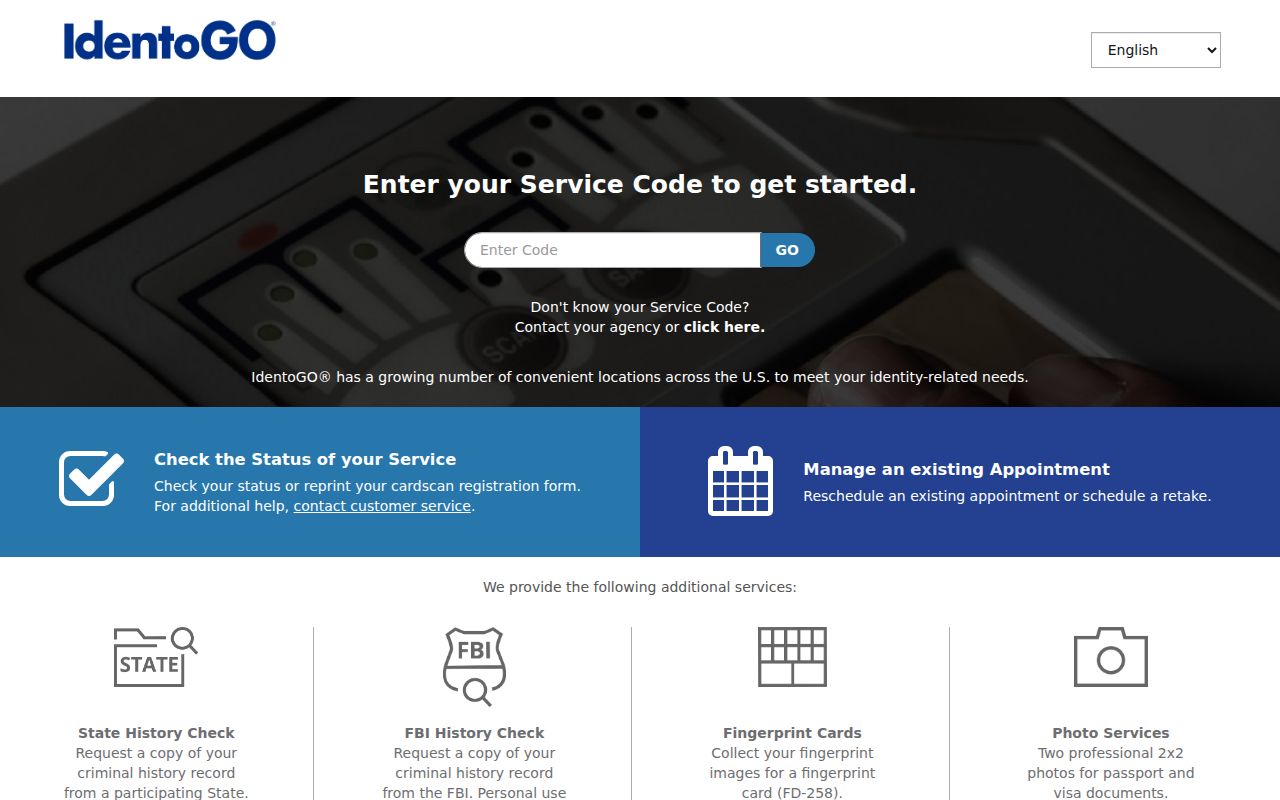
The interface confirms why no fixed local appointment location should be promised. Bring the identity documents listed in the appointment confirmation and keep the receipt or tracking number. For scheduling help, DPS publishes 1-888-467-2080.
Fingerprint review is most useful for checking one's own Texas repository entry, finding a missing disposition, and starting an identity-error correction. A Floyd County clerk file still supplies the underlying judgment and pleadings.
City-by-City Criminal Records in Floyd County
Floyd County has two incorporated cities. Texas Demographic Center estimates for January 2024 rank Floydada first at 2,555 people and Lockney second at 1,441. Their records routes differ. Floydada is the county seat, so city police, municipal court, Sheriff, courthouse, and justice-court contacts are close but remain separate custodians. Lockney record searches more often move from a local city or justice contact to county offices in Floydada.
Floydada Record Check
2,555 residents · City police and municipal records connect to nearby county offices.
Lockney Record Check
1,441 residents · Local citation and incident routes may hand off to Floydada custodians.
Use each city page for the local handoff, then return to the county clerk or Sheriff when the record moves into the county system.