
Criminal Court Cases in Floyd County
Floyd County does not send every criminal charge to one court. The official district-court directory confirms that the 110th Judicial District Court hears felony matters, while its District Clerk keeps the filed felony case record. Class A and B misdemeanors ordinarily go to the constitutional Floyd County Court and the County Clerk because the county has no county court at law. Fine-only misdemeanors, failures to appear, and related capias entries may remain with a justice or municipal court. The Texas trial-court jurisdiction maps provide the state framework for that split.
The Floyd County court file is case-centered. It starts when a complaint, information, or indictment is filed and grows as the court enters settings, motions, pleas, orders, and a judgment. An agency arrest report and jail booking are separate. When an initial charge matters, compare those agency records with the filed case instead of treating either one as the whole Floyd County criminal record.
The official 110th District Court page shows the court office used for Floyd County felony proceedings.
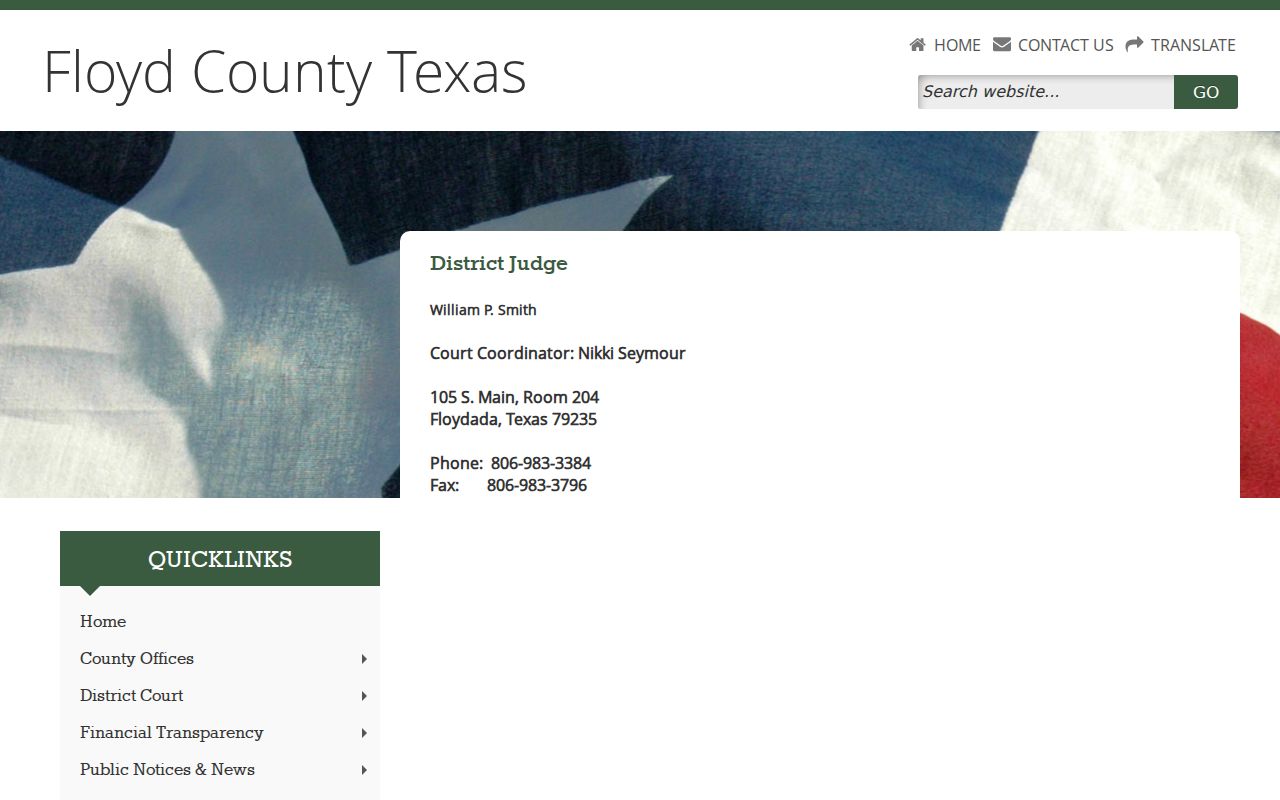
That office is the trial court, while the District Clerk remains the custodian to contact for filed pleadings and certified copies.
Floyd County Case Offices by Room
Several parts of a felony case sit in one courthouse but behind different doors. The 110th District Court is in Room 204. The District Clerk is in Room 207, and the 110th District Attorney is in Room 200. The County Attorney, who is relevant to misdemeanor prosecution, is in Room 209. These close locations do not merge their duties. The judge manages the court, the prosecutors make charging decisions, and the clerk preserves the official case file. The Texas county-office directory is an additional official-office validation route.
Floyd County District Clerk
105 S. Main St., Room 207
Floydada, TX 79235
806-983-4923
mjcisneros@co.floyd.tx.us
110th District Court
105 S. Main St., Room 204
Floydada, TX 79235
806-983-3384
districtcourt@co.floyd.tx.us
Floyd County Clerk
105 S. Main St.
Floydada, TX 79235
806-983-4905
Confirm the correct misdemeanor file desk.
The District Clerk page publishes direct contact information, criminal e-filing notices, and Floyd County case-number guidance.
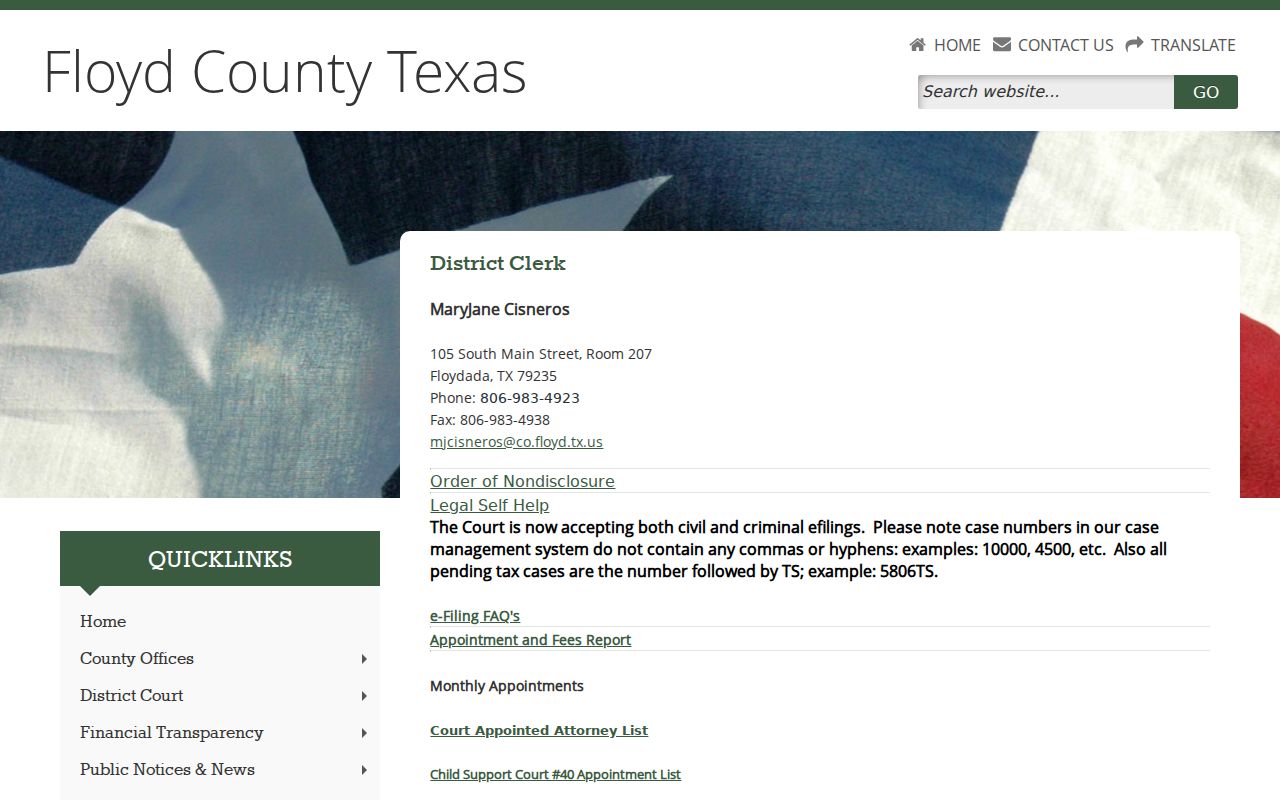
Use that office for felony case identification, inspection options, copy prices, certification, and older-file retrieval.
Floyd County Case Record Searches
No verified Floyd County criminal-case portal supplies a complete name search. A careful lookup begins by matching the offense level to its court, then asking for the narrowest useful record. A case number is best. If it is unknown, give the exact name and an approximate filing year, but understand that the County Clerk warns staff will not perform searches beyond those authorized by law.
- Identify whether the matter is a felony, Class A or B misdemeanor, or fine-only case, then choose the District Clerk, County Clerk, justice court, or municipal court.
- Provide the party name, approximate year, and case number when known. Enter or repeat Floyd County District Clerk case numbers without commas or hyphens.
- Ask first for the docket or register of actions. It can identify the filed charge, key dates, and the documents worth ordering.
- Read each event in sequence and distinguish a setting, plea, dismissal, deferred adjudication, judgment, and sentence.
- Request inspection, plain copies, or certified copies from the custodian. Confirm retrieval time, accepted payment, per-page charges, and certification cost before ordering.
| Lookup detail | Type | Needed | Floyd County use |
|---|---|---|---|
| Case number | Text | Best when known | Give digits without commas or hyphens. |
| Defendant name | Text | Needed without a number | Use the full legal name and known variants. |
| Approximate year | Date range | Strongly useful | Narrows active and archived files. |
| Offense level | Category | Routing detail | Separates district, county, justice, and city courts. |
| Document type | Request choice | For copies | Ask for docket, charging paper, judgment, or sentence. |
These are request details for a clerk-assisted search, not fields from an online Floyd County criminal portal. Confirm the office's current search limits before sending payment.
Why Floyd County Cases Evade re:SearchTX
re:SearchTX may look like a statewide answer, but it is not the criminal fallback for Floyd County. An official Texas Judicial Council data report states that the platform's statewide collection excludes criminal case records. Court participation, account role, and document access also affect what appears. A blank result there does not establish that no Floyd County criminal court case exists.
The re:SearchTX interface is useful evidence of how the state platform accepts searches, not proof of county criminal coverage.
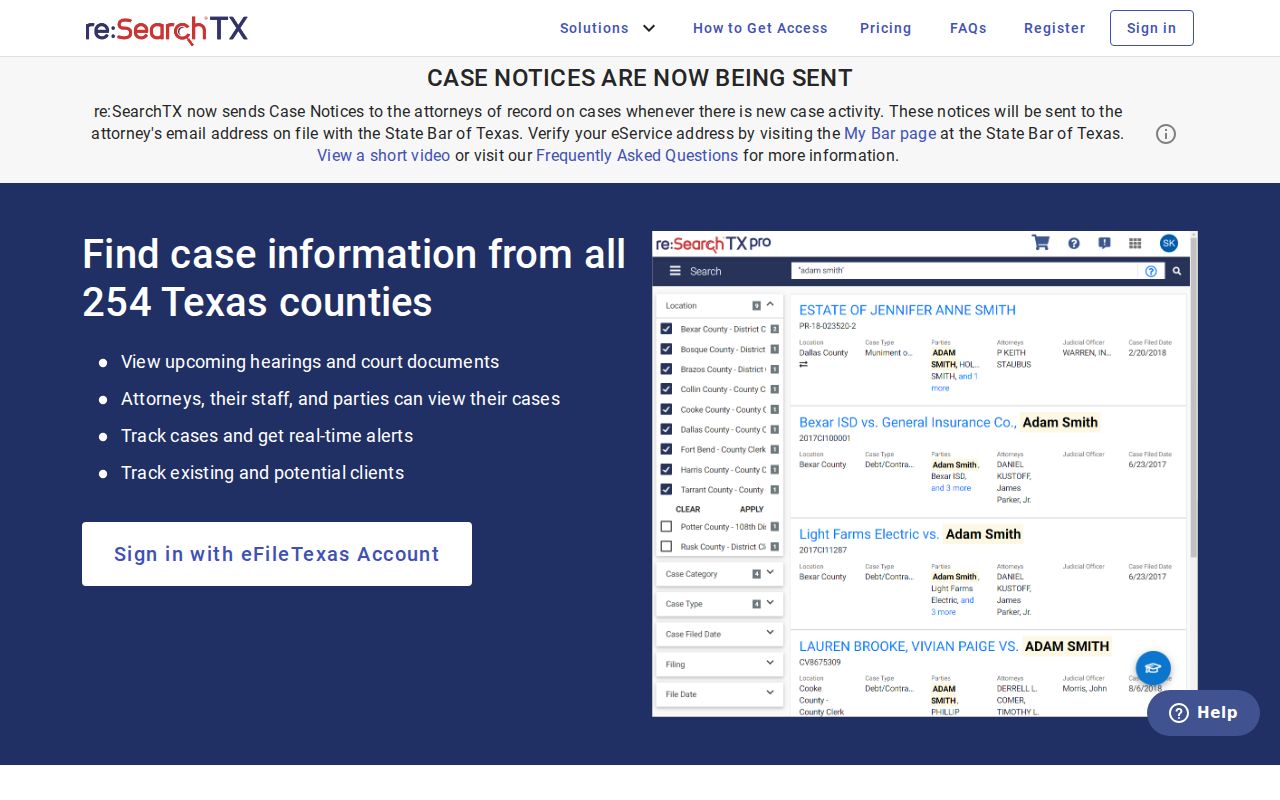
When the platform is silent, return to the correct Floyd County clerk. For a federal prosecution, search PACER and the Northern District of Texas separately because the county courthouse cannot certify federal dockets.
What a Criminal Case File Contains
A Floyd County criminal case file is organized around one prosecution. Its Floyd County case header identifies the number, court, filing date, style, category, and status. Party and attorney entries identify the State of Texas, the defendant display name, and counsel where entered. Charges may include the offense description, statute, degree or class, and separate count numbers. The docket then records filed documents and court action in date order.
| Case number and court | Identifies the Floyd County tribunal and the file used for later requests. |
|---|---|
| Charging document | A complaint, information, or indictment states the accusation actually filed in court. |
| Docket entries | Show filings, settings, motions, pleas, orders, capias entries, and appeal activity when applicable. |
| Hearing dates | Record scheduled and completed court events, which do not by themselves state an outcome. |
| Disposition and judgment | Distinguish dismissal, acquittal, deferred adjudication, and conviction. |
| Sentence and financial record | May show confinement, community supervision, fines, court costs, restitution, and ledger entries. |
Some docketed documents may be available only under the court's access rules, and public copies omit protected personal data. No private Floyd County defendant record was used to form this field list. It reflects the official Texas court-system schema and the items a clerk-file request can seek.
Three Floyd County Charge Records
A booking charge, filed charge, and judgment answer different questions. The arresting agency and intake staff record what they received at arrest. The District Attorney or County Attorney then decides whether and what to file. The trial court's judgment states the final adjudicated result. The wording, offense level, and number of counts can change at each stage.
- Booking charge
- The arrest-stage allegation entered for intake and bond processing. It is not a court finding.
- Filed charge
- The accusation placed before the Floyd County court through a complaint, information, or indictment.
- Disposition
- The recorded outcome, such as dismissal, acquittal, deferred adjudication, or conviction.
- Judgment
- The court's formal written decision, often paired with sentencing and cost information.
The 110th District Attorney page shows the felony prosecutor's courthouse office and public contact form.
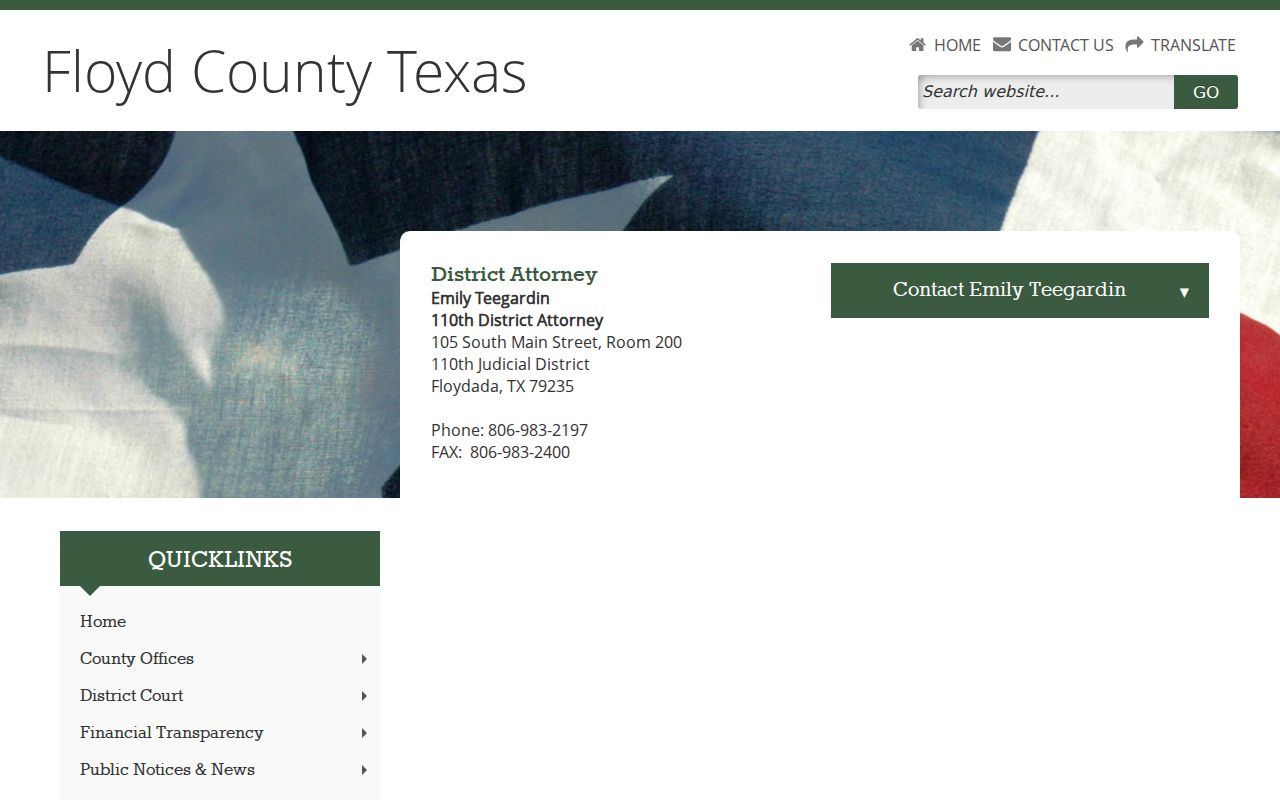
The form is an office contact route, not a case-search tool. Filed documents still come from the clerk, and the prosecutor cannot provide defense advice.
Criminal Case Stages in Floyd County
After a Floyd County arrest or summons, a magistrate addresses warnings, probable cause, and bail. Texas law calls for an arrested person to be taken before a magistrate without needless delay, generally no later than 48 hours. Prosecutor review follows. Most felony cases proceed through a grand jury before indictment, while misdemeanor prosecution may use an information. Arraignment, discovery, pretrial motions, a plea or trial, judgment, and sentencing come later.
Case flow: Charges Filed › Arraignment › Pretrial › Plea or Trial › Disposition › Sentencing
Not every Floyd County case completes each step in the same form. A prosecutor may dismiss a count, a grand jury may decline to indict, or an agreement may resolve the case before trial. An appeal or community-supervision entry can extend the record after judgment. Read the dated docket rather than guessing from a single status label.
Start With the Floyd County Case Register
The Floyd County register of actions is a practical first request when a whole file may be large. It gives a dated map of the case and helps isolate the indictment or information, plea papers, judgment, sentence, and orders that answer the research question. Inspection may be available without buying every page, but Floyd County does not publish a comprehensive criminal copy-fee schedule. Ask the custodian for current costs and service options.
Small formatting details prevent wasted calls. The District Clerk tells e-filers that local case numbers contain no commas or hyphens, using plain digit examples. Repeat the number in that form. For an older matter, give the year and ask whether retrieval is needed. The Texas State Library's county microfilm inventory also shows why some historic records may be organized by series, volume, or reel rather than a modern name index.
The Floyd County Clerk page lists the misdemeanor custodian's hours and separate filing cutoffs.

Call before traveling because filing deadlines do not necessarily equal criminal-copy counter service times.
Access Rules for Case Records
Open access to Floyd County case records does not mean every item appears without limits. Texas court rules require sensitive-data redaction. Social Security numbers, full account numbers, protected victim or minor data, juvenile material, sealed filings, and other confidential details are withheld or masked. A public docket may show that an event occurred while the document itself remains restricted.
The Texas Public Information Act supports prompt access to identifiable agency records and provides exceptions for some law-enforcement material. The Texas court rules frame access to filed court records. Those systems overlap but are not identical. Ask for releasable portions with redactions if a complete copy cannot be released.
A sealed, expunged, or nondisclosed record may not appear in an ordinary public search. Expunction under current Texas Code of Criminal Procedure Chapter 55A can require covered records to be returned, deleted, or destroyed. Nondisclosure limits public release but preserves access for authorized agencies. Neither result should be inferred from a blank name search.
When Floyd County Case Outcomes Are Missing
A missing disposition in a Texas DPS history does not prove the Floyd County case is still pending. The Floyd County clerk or prosecutor may have reported the result late, an older submission may be incomplete, or an agency record may not have linked correctly. Obtain the court's judgment or dismissal first. A certified copy carries more weight when asking an originating office or DPS to review a gap.
Work from the source outward. Confirm the Floyd County case number, compare the arrest-cycle identifiers, and ask the clerk whether the outcome was sent through the reporting chain. Then use the Texas Department of Public Safety Crime Records Division's correction or review instructions. DPS cannot create a court result that the local source never supplied.
For broader context, the county's criminal history overview distinguishes the courthouse file from the DPS name search and fingerprint-based self-review. Each is a different record product.
Note: A dismissal, acquittal, deferred adjudication, and conviction have different legal meanings and should never share one shorthand label.